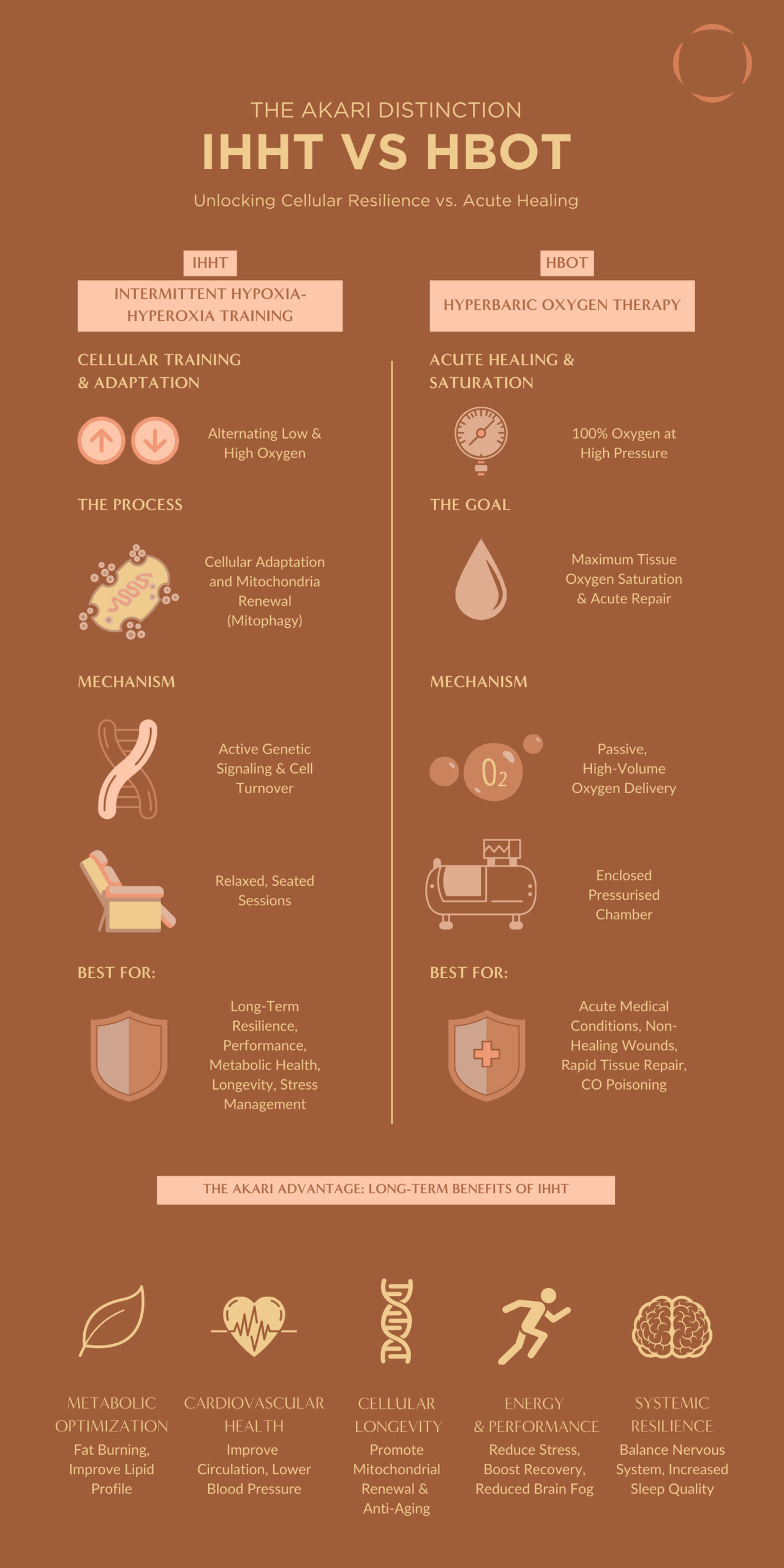
It’s one of the most common questions we hear: Is Intermittent Hypoxia-Hyperoxia Training (IHHT) the same as Hyperbaric Oxygen Therapy (HBOT)?
While both modalities rely on the power of oxygen, the similarity ends there. At AKARI, we understand that achieving true longevity and performance requires more than oxygen saturation, it requires cellular adaptation.
Let’s dive into the science to compare these two powerful tools and explain why the choice between treating and training is essential for your long-term vitality.
HBOT: The High-Pressure Intervention
Hyperbaric Oxygen Therapy (HBOT) is an established medical procedure rooted in a simple principle: physics.
The Mechanism of Saturation
HBOT involves delivering 100% pure oxygen at atmospheric pressures significantly higher than sea level (typically 2 to 3 times the norm) [1]. This increased pressure forces dramatically more oxygen to dissolve directly into the bloodstream’s plasma, bypassing the need for haemoglobin to transport it. The primary goal is achieving maximum tissue oxygenation, especially in areas struggling with low blood flow or infection [2].
The Role: Acute Healing
Due to its high-impact delivery, HBOT is clinically validated for a specific set of acute and chronic conditions where rapid, massive oxygen delivery is crucial. These established uses include treating decompression sickness, carbon monoxide poisoning, severe infections, and accelerating the healing of non-healing wounds and radiation injuries [2].
HBOT is an invaluable treatment for critical tissue oxygen deprivation, acting as a deep and targeted intervention.
IHHT: The Adaptive Cellular Training
IHHT operates on a completely different premise: harnessing controlled stress to drive the body’s natural power of adaptation, echoing the benefits of high-altitude training without the physical strain.
The Mechanism of Renewal
Instead of saturation, IHHT focuses on optimization. The therapy involves alternating brief periods of reduced oxygen (hypoxia, stimulating a challenge) with periods of enriched oxygen (hyperoxia, assisting recovery). This gentle, cyclical stress is the key to stimulating profound cellular change:
- Activation of Mitochondrial Autophagy: The hypoxic state acts as a signal, encouraging the body to selectively eliminate old, damaged, or dysfunctional mitochondria, the power plants of your cells. This process is known as mitoptosis or mitophagy [3].
- Mitochondrial Biogenesis: The subsequent hyperoxic phase provides the necessary oxygen fuel to help generate new, healthier, and more efficient mitochondria to replace the old ones.
The result is not just more oxygen, but a body that utilizes the oxygen it has, far more efficiently.
The AKARI Synthesis: Training vs. Treating
At AKARI, our focus is on building systemic resilience, and the research points strongly to IHHT as the superior tool for proactive health and longevity through cellular fitness:
| IHHT is proven to drive sustained improvements in key health metrics: | Scientific Backing |
| Metabolic Health | IHHT significantly improves the lipid profile, including reducing total cholesterol and LDL, and decreases inflammatory markers in individuals with metabolic syndrome [5]. |
| Systemic Resilience | The therapy improves the balance of the vegetative nervous system (VNS) by reducing sympathetic drive and improving heart rate variability (HRV) [4]. |
| Cardiovascular Performance | IHHT conditioning leads to measurable improvements in resting heart rate, and significantly reduces both Systolic and Diastolic Blood Pressure (SBP/DBP) [4]. |
| Energy & Performance | By cultivating a healthier population of mitochondria, the body’s overall capacity for endurance and exercise tolerance is enhanced [3, 4]. |
While HBOT is excellent for healing a medical crisis, IHHT is the necessary training regimen for peak performance, stress management, and sustained energy across your lifespan. It is the tool that forces your cells to become fitter, faster, and more efficient.
Scientific References
[1] A General Overview on the Hyperbaric Oxygen Therapy: Applications, Mechanisms and Translational Opportunities. PMC (2021). [2] Hyperbaric oxygen: its uses, mechanisms of action and outcomes. QJM – Oxford Academic (2004). [3] Mitochondria as a Target of Intermittent Hypoxia. ResearchGate (2015). [4] Safety and Efficacy of Intermittent Hypoxia Conditioning as a New Rehabilitation/Secondary Prevention Strategy for Patients with Cardiovascular Diseases. Systematic Review & Meta-analysis, PMC (2021). [5] The Effects of Intermittent Hypoxic–Hyperoxic Exposures on Lipid Profile and Inflammation in Patients With Metabolic Syndrome. Frontiers in Cardiovascular Medicine (2021).